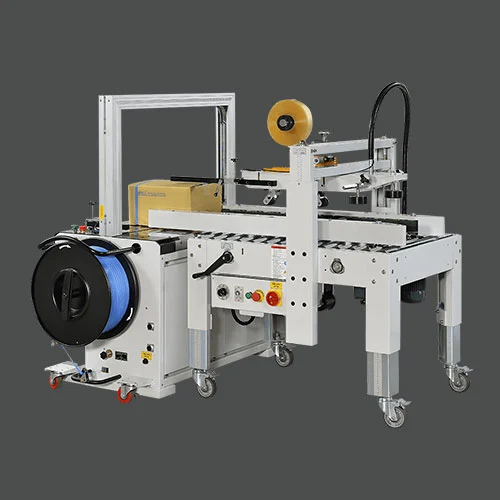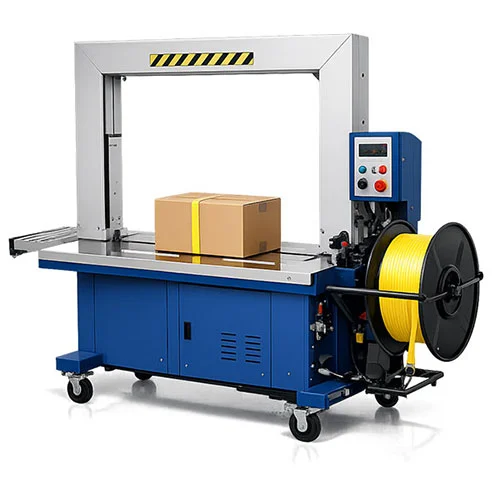

At Pooja Plastic Industries, we understand that in today’s fast-paced manufacturing world, efficiency, reliability, and speed are key to keeping your packaging lines running smoothly. That’s why we’ve developed high-performance Automatic Strapping Systems designed to streamline your packaging operations, increase productivity, and ensure that your products are securely strapped and ready for shipment with minimal effort.
Our Automatic Strapping Systems are engineered to integrate seamlessly into your existing packaging lines, delivering consistent, reliable results every time. Whether you're packaging small boxes, palletized goods, or bulk shipments, our systems are built to handle it all with precision and speed—keeping your operation running efficiently and reducing labor costs.
An automatic strapping system is a machine that automatically applies, tensions, seals, and cuts strapping around packages on a packaging line without manual intervention.
They are widely used in manufacturing, logistics, warehousing, e commerce, food and beverage, pharmaceuticals, and distribution centers to secure cartons, bundles, and pallet loads.
Packages move on a conveyor into the strapping head, where the system feeds the strap around the package, tightens it to the set tension, seals or welds it, and then cuts the strap — all automatically.
Most systems work with PP (polypropylene) and PET (polyester) strapping in various widths, depending on the machine’s design and application requirements.
Key benefits include higher throughput, consistent tensioning, reduced labor costs, improved safety, and reliable packaging quality across high volume operations.
Yes — automatic strapping systems can be integrated with conveyors, labelers, check weighers, and other packaging equipment to create a seamless automated workflow.
Important features include adjustable tension settings, fast cycle speed, easy strap reel loading, durable sealing technology, safety sensors, and low maintenance design.
Yes — regular maintenance like cleaning, lubrication, inspection of wear parts, and periodic calibration helps ensure long term performance and reduces downtime.